Partner Harriet Elphinstone-Dick
Queer Places:
9 Old Steine, Kemptown, Brighton and Hove, Brighton BN1 1EJ, UK
The Steyne (later Newstead Forest), 85 A'Beckett Rd, Beaconsfield Upper VIC 3808
South Head Cemetery, Old South Head Rd, Vaucluse NSW 2030, Australia
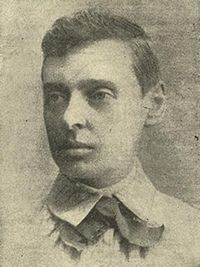 Caroline Mercy Alice Moon (July 4, 1855 - April 21, 1894) born on July 4, 1855, in Brighton, England, was the daughter of the prosperous physician Dr. Henry Moon and
Caroline (née Gardner). She grew up in Brighton—a city noted in the Victorian era as a place where same-sex relationships could find a degree of clandestine community and
space away from strict societal surveillance.
Caroline Mercy Alice Moon (July 4, 1855 - April 21, 1894) born on July 4, 1855, in Brighton, England, was the daughter of the prosperous physician Dr. Henry Moon and
Caroline (née Gardner). She grew up in Brighton—a city noted in the Victorian era as a place where same-sex relationships could find a degree of clandestine community and
space away from strict societal surveillance.
In her early twenties, Alice met Harriet Elphinstone-Dick, a prominent champion swimmer and celebrity in both
Britain and Melbourne. The two women formed a profound personal and domestic partnership, ultimately deciding to emigrate together.
In 1876, Alice and Harriet arrived in Australia. Reflecting the ideals of the 'New Woman' movement—independent, career-minded, professional, and advocates for clothing
reform such as shedding tight corsets—the couple forged independent paths while building a life together.
Following Harriet's retirement from competitive swimming, the couple opened one of Australia's earliest gymnasiums dedicated exclusively to women in Melbourne. Located
eventually in the grand Victoria Building on Swanston Street, the enterprise introduced the new sport of callisthenics to Australian women.
Seeking a country retreat, the couple acquired 40 acres of land in Upper Beaconsfield, outside Melbourne. They built a cottage named The Steyne (later known as Newstead
Forest) after Alice's Brighton family address. While Harriet commuted daily to Melbourne to run the gymnasium, Alice managed an organic poultry farm on the property. Local
neighbors affectionately and respectfully dubbed the independent pair "the Amazons."
By 1888, the couple sold their Upper Beaconsfield property. Alice established a restaurant on Little Collins Street in Melbourne, but eventually sought new horizons.
Restless and with their relationship running its course, Alice broke off the partnership in 1890 and relocated to Sydney to pursue a career in journalism.
In Sydney, Alice resided with a family in Double Bay, immersed herself in writing, and actively sailed a yacht named The Lark.
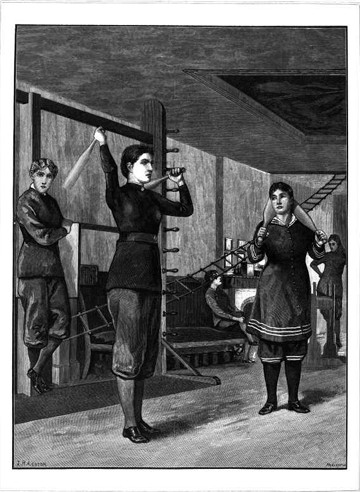
From the AUSTRALASIAN SKETCHER July 16th 1881. Harriet is demonstrating the Indian clubs while Alice stands behind her.
In May 1894, at the age of 38, Alice contracted a sudden illness shortly after interviewing the prominent Sydney metallurgist and bacteriologist John McGarvie Smith.
She passed away on April 21, 1894, at the residence of Walton L. Merewether in Double Bay, with her death officially attributed to heart disease.
She was laid to rest at the South Head Cemetery (now Vaucluse, Waverley Council) in New South Wales.
Her headstone features a cryptic biblical quotation from the Book of Job: “When he giveth quietness, who then can make trouble?”
Though documentation in the form of personal diaries and letters from the era remains scarce, public records, sporting clubs, newspaper notices (such as her obituary in
The Argus), and biographers like Sue Ingleton have cemented the historical understanding of Alice Moon and Harriet Elphinstone-Dick as pioneering life partners. They stand
as enduring symbols of 19th-century independence, professional enterprise, and queer history in both Britain and Australia.
References:
- A History of LGBTIQ+ Victoria in 100 Places and Objects
- https://stkildahistory.org.au/images/People/harriet_elphinstone_dick/big_race_article.pdf
- Queer Goldfields Historical Project: https://queergoldfields.au/harriett-and-alice-moon
- Upper Beaconsfield Local History: Records concerning The Steyne (later Newstead Forest)
- https://stkildahistory.org.au/images/People/harriet_elphinstone_dick/big_race_article.pdf
Support this project
This website is a passion project researched, developed, and funded entirely by me. If you find the content valuable and would like to help support the ongoing research and hosting costs, any contribution is deeply appreciated.
Thank you for keeping this independent resource alive!
My books on Amazon: Elisa Rolle's books
BACK TO HOME PAGE